
Did Michael Collins want to die?
Exploring the curious decision made by Michael Collins to stop and fight the Anti-Treatyites on the day of his death.
Pádraig mac Aodha
7/20/20264 min read
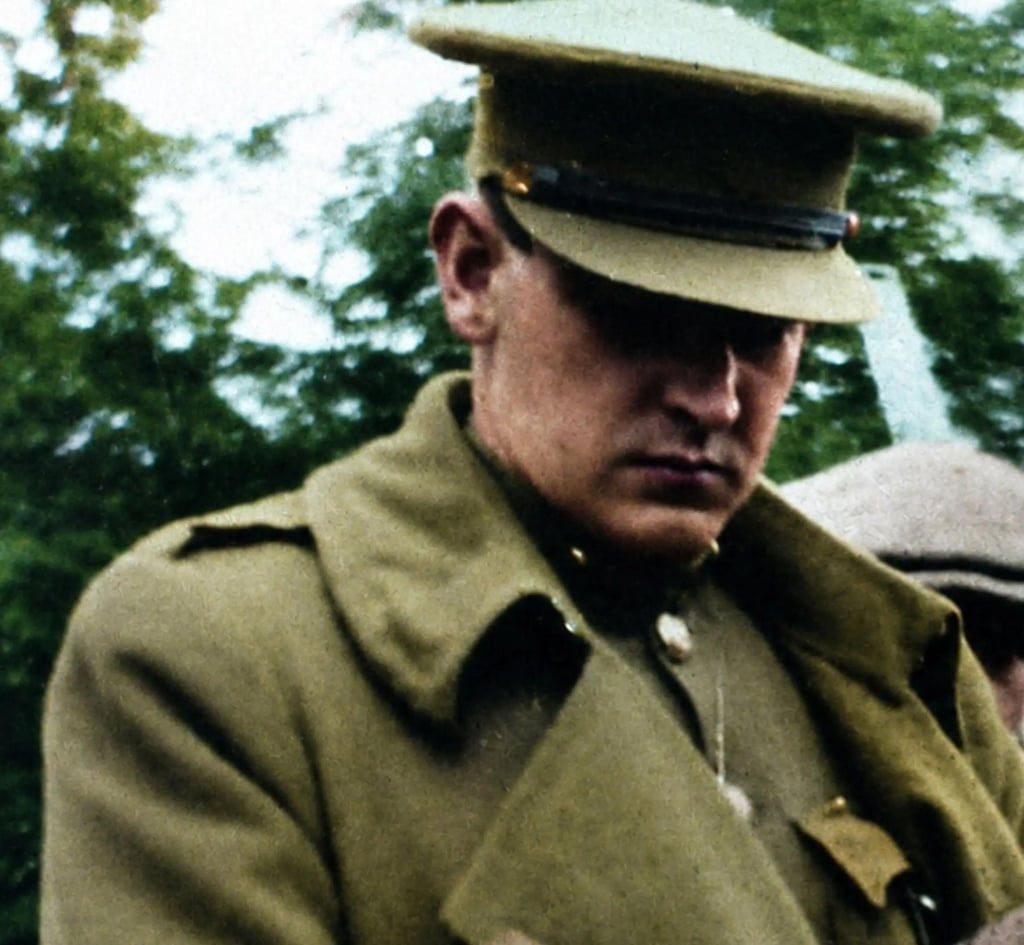
One of the bigger mysteries surrounding the Béal na Bláth ambush, for me at least, has never been the usual "whodunnit" but rather the curious decision made by Michael Collins to stay and fight, despite the advice of Major General Emmet Dalton, who urged the men, "Drive like hell."
You see, whilst the convoy was already having enough difficulty getting to Béal na Bláth — and through Cork in general — it's fair to say that Collins still had a chance to escape. The Anti-Treaty IRA, who had lain in wait for hours, had already begun dismantling the barricades and obstructions they had erected, believing the convoy had already passed. Yet, despite this opportunity, Collins countermanded Dalton's order to drive on, replying instead, "Stop, and we'll fight them."
However, is this actually much of a mystery?
In the days leading up to the ambush, Collins had lost something that was simply irreplaceable: Arthur Griffith. Since the signing of the Anglo-Irish Treaty, the pair had become almost inseparable, working long into the night to build the new state they had helped establish. Griffith's sudden death on August 12th, 1922, left Collins not only without his closest political ally but also carrying an even greater burden as Chairman of the Provisional Government and Commander-in-Chief of the National Army.
Collins himself was also unwell, ignoring the advice of his doctor, who urged him not to make the journey to Cork. Months of near-constant work, endless meetings, military reports, political crises, and the crushing weight of leadership had left him physically exhausted. He scarcely had a moment to grieve Griffith before once again throwing himself into the war effort.
And, on that note, perhaps most heartbreaking of all, a brother-against-brother war was now in full swing. Comrades who had only recently fought side by side against their common enemy now found themselves so bitterly divided that they had turned their guns on one another. Dublin had been shelled in June. Fighting had spread across much of the country. Former friends now faced each other across barricades, while reprisals were becoming an increasingly grim reality.
Harry Boland, another close friend of Collins, had already been killed by National Army forces after being shot during an attempted arrest. Boland had been one of Collins' oldest companions and, despite finding themselves on opposite sides of the Treaty split, Collins was deeply affected by his death. For a man who had spent years building the IRA into a united fighting force, watching it fracture so completely must have been devastating.
Here is a quote from Collins in a letter to Kitty Kiernan after Boland's death:
"I passed St. Vincent's Hospital today and thought of him lying there dead. I'd send a wreath but I suppose they would return it. My mind is full of things. My heart is heavy."
The loss of a friend is never easy, but imagine losing multiple in the same year, some of whom to the aforementioned brother-on-brother war.
With Collins' exhaustion came increasingly eerie premonitions. He seemed to believe that he had signed his "own death warrant" and, during a meeting with Winston Churchill, remarked:
"I shall not last long; my life is forfeit, but I shall do my best. After I am gone it will be easier for others."
Was he under the impression that if he were to die, things would somehow become easier? Perhaps he believed that, in death, he might remove one of the principal causes of division amongst former comrades.
Of course, following his death, the opposite proved true. If anything, matters became far worse. His death undoubtedly hardened attitudes amongst many in the National Army and deprived the Free State of the one man who perhaps stood the greatest chance of bringing the conflict to a swifter conclusion.
All in all, it was undoubtedly a very dark period for everyone involved, but especially for the man who had once commanded the respect and loyalty of men on both sides.
General Richard Mulcahy, one of Collins' closest colleagues, later reflected on the state Collins was in during the days before the ambush:
"Every bit of his small grain of corn died and re-died night and day during the last four or five years... On Saturday, the day before he went on his last journey to Cork, he sat with me at breakfast writhing with pain from a cold all through his body, and yet he was facing his day's work..."
Then came the morning of August 22nd.
Joe O'Reilly later recalled seeing what he described as a "so tragically dejected" Michael Collins. As Collins waited for the convoy, O'Reilly remembered him standing with his head slumped.
"He wore a small green kitbag over his back, his head was bent in gloomy meditation, and O'Reilly thought he had never seen so tragically dejected a Collins as this man who, thinking himself unobserved, let himself fall slack in the loneliness and silence of the summer morning."
— Frank O'Connor, The Big Fellow (1937), recounting the recollections of Joe O'Reilly —
The question I often ask myself now is this:
Did Collins want to die, or did he simply no longer care whether he lived or died?
The answer, of course, is one we'll never know, and history simply does not allow us to say with certainty. After all, the Big Fellow is not here to tell us how he felt and why he made such a strange decision.
The other real possibility is that Collins simply allowed his fiery temper — something he had certainly displayed before — to get the better of him. During the ambush, he moved into a relatively exposed position, away from much of the rest of the convoy, in an attempt to get a better shot at the retreating Anti-Treaty IRA men. It was there that he received the single fatal shot to the head.
Joe O'Reilly had also pleaded with Collins not to go to Cork, but Collins reportedly responded:
"They'll never shoot me in my own county."
Was the harsh reality — that they were, in fact, shooting at him in his own county — something that ignited that famous Collins temper? Was his decision to stand and fight driven less by military necessity than by anger, frustration, exhaustion, and perhaps even a sense of fatalism?
We'll never know for certain.
Perhaps Collins simply believed he was invincible. Perhaps he truly believed they could take the Anti-Treatyites on with ease. Perhaps he was exhausted beyond reason. Perhaps grief, illness, anger, and months of relentless pressure clouded his judgement. Or perhaps he truly believed that no one would ever shoot him "in his own county."
Whatever the truth may be, one thing is certain: when the order came to "Drive like hell," Michael Collins chose instead to stop and fight.
That single decision changed the course of Irish history forever.