

You don't need to be born in Ireland to be an Irish revolutionary
James Connolly's life proves you do not need to be born in Ireland to be an Irish revolutionary.
Pádraig mac Aodha
7/16/20262 min read
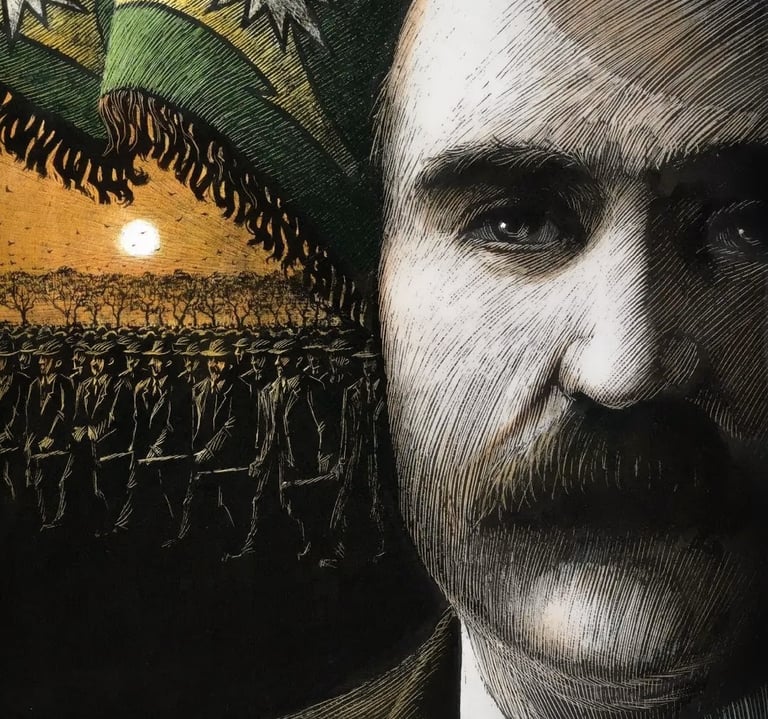
James Connolly, regarded by many as Ireland's greatest revolutionary, was born in Edinburgh, Scotland, in 1868. His parents were immigrants from County Monaghan living in the "Cowgate" district — a slum colloquially known as "Little Ireland." Though he spoke with a lifelong Scottish accent, Connolly was raised in a deeply Irish atmosphere, surrounded by Gaeilge speakers and the survivors of the Great Famine. This childhood in systemic poverty taught him that the struggle for Irish identity was inseparable from the struggle against class oppression.
At age 14, to escape crushing poverty, Connolly joined the British Army under the pseudonym "John Reid." He served for seven years, primarily in Ireland. This period was his radicalization: he witnessed the Land Wars, where the British Army’s primary duty was to enforce the brutal eviction of starving Irish peasants. Seeing the military used as a tool for landlords turned Connolly against the Crown. In 1889, facing a transfer to India, he deserted and returned to Scotland, having learned the tactical inner workings of the empire he would later fight.
Connolly returned to Ireland in 1896 to found the Irish Socialist Republican Party and then, after several years organizing labour in the United States, he returned in 1910, for good, to lead the movement alongside James Larkin. During the 1913 Dublin Lockout, police brutally attacked striking workers on "Bloody Sunday." In response, Connolly, Larkin, and Captain Jack White (a former British officer) formed the Irish Citizen Army (ICA) — a militia of armed workers.
Initially, they trained with hurling sticks because they lacked rifles, but their presence alone deterred police violence. Under Connolly’s later leadership, the ICA became a revolutionary force dedicated to overthrowing British rule and establishing a Socialist Republic.
As World War I raged on, Connolly feared the British would impose conscription on Ireland. He threatened to lead his small ICA into a rebellion alone if the larger Irish Volunteers did not act. To prevent a premature uprising, the Irish Republican Brotherhood (IRB) held Connolly for three days in January 1916 to negotiate. He joined their Military Council, merging the two movements.
On Easter Monday, 1916, Connolly marched the ICA to the General Post Office (GPO) under the Starry Plough banner. While Padraig Pearse was the voice of the Rising, Connolly, as Commandant-General of the Dublin Division, was the tactical mastermind. He directed the defense of the GPO even after being wounded twice. By the surrender on April 29, his second wound — a shattered ankle — had developed gangrene.
While other leaders were sent to Kilmainham Gaol, the wounded Connolly was taken to the hospital at Dublin Castle. His court-martial was held while he lay in bed. On May 12, 1916, he was taken to Kilmainham by ambulance. Because he could not stand, he was tied to a chair in the yard and executed by firing squad.
James Connolly's life proves that you don't need to be born in Ireland to be an Irish Revolutionary.
Written by: